
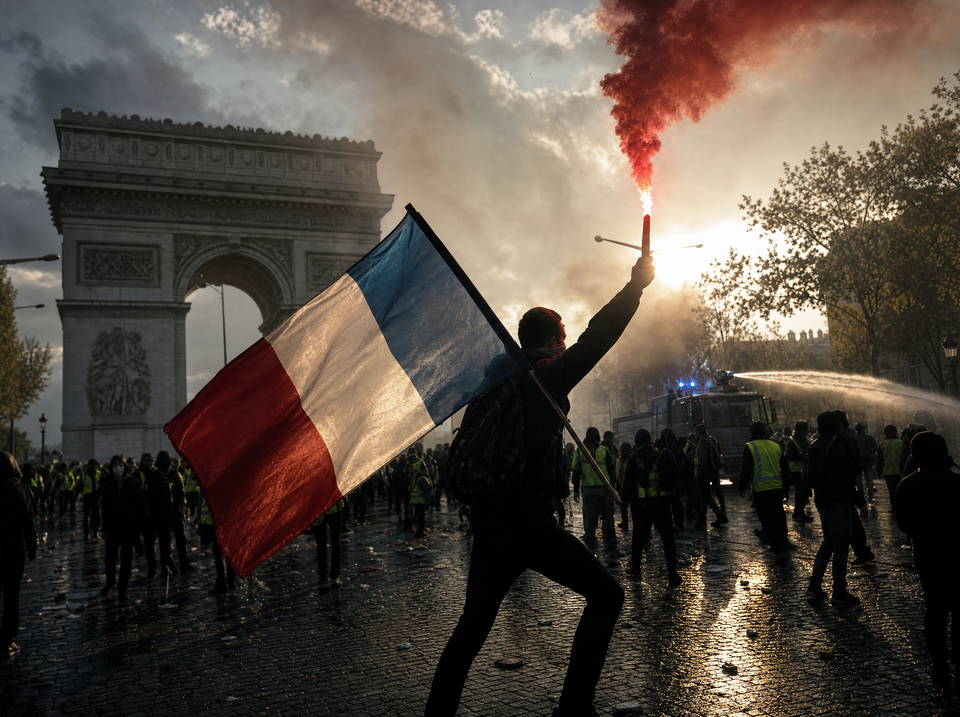
Someone forwarded me a video on Sunday. Cars on fire in Paris, smoke over a square, riot police everywhere. The caption said "France is finished."
It isn't finished. But it is rioting, and it's worth understanding why.
Here's what happened. On 17 October, somewhere between 550,000 and 800,000 people marched across France, depending on whether you believe the government or the unions. They were angry about the cost of living and the price of fuel. In Paris, Marseille and Lyon, parts of it turned into rioting and looting. In Limoges, somebody burned down the town hall. Curfews went up in several areas, and this Saturday the government is putting soldiers on the streets next to the police.
There is a war in this story, just not in France. French jets and ships have been shooting down drones in the Middle East since March, after the US and Israel went to war with Iran. That's where the riots actually start. Oil routes got disrupted, fuel got expensive, and six months later the bill arrived in French living rooms.
So underneath the fire and the looting, this is a riot about bills. That's the useful part for us, because most of us will never be caught in a riot. Almost all of us will live through a price shock.
Here's what I took from it.
The headline is the first decision you make
Watch the clips and you'd think the whole country was burning. It wasn't. Hundreds of thousands of people marched peacefully. The burning and looting came from smaller groups on the edges. But "France is finished" spreads, and "mostly peaceful march, some looting" doesn't. Your brain grabs the scarier version and runs with it, and the scarier version is usually the less accurate one.
That matters for money because a lot of financial damage starts right there. Someone reads a headline, feels something, and sells, buys, or panics before checking if the thing is even true. I lost money in forex at 18. Looking back, most of my worst calls from that period started with a feeling, not a number.
The fix is boring. Before you act on news, find out what actually happened. It took me about ten minutes to go from "France is finished" to "France has a fuel price and debt problem." Those are two completely different situations, and they call for completely different moves.
Nobody riots over GDP
Notice what people were actually shouting about. Not inflation statistics. Not the deficit. Petrol.
There's a reason for that. You see the price of fuel every week. You feel it every time you fill up. So for most people, the pump becomes their personal inflation number, even if fuel is only a slice of what they spend. Things you buy often feel bigger than things you buy rarely, even when the rare stuff costs more.
I learned how energy costs sit under everything the hard way. When I was mining Ethereum, the thing that killed it first wasn't the price of ETH. It was the electricity bill. (Then a GPU died, which settled the matter.) Energy is the cost under every other cost. When it moves, everything built on top of it wobbles. Transport, food, delivery, the price of your kopi.
Most of us will never be caught in a riot. Almost all of us will live through a price shock.
The fuel price was the match. The wood had been stacking for years.
Most people miss this part. The French protests didn't start with fuel at all. They started last month in high schools in the working-class suburbs north of Paris, with students angry about teacher shortages and run-down classrooms. Then teachers and unions joined. Then people angry about fuel and living costs. Then the yellow vests came back. Then the looters showed up, because looters always show up.
No single thing caused 17 October. It was a pile of grievances that finally met a spark.
Personal finance works exactly like this. When someone tells me a car repair "ruined" their month, the car repair is almost never the real problem. The real problem is that they had zero buffer, a credit card balance they'd been rolling for a year, and a lifestyle sized to their best month instead of their average one. The repair was just the match.
The lesson
The thing that breaks you is rarely the last expense. It's everything that was already stacked up when the last expense arrived.
Nobody looted the bookshop
Look at what got hit on 17 October. Luxury boutiques. Supermarkets. A perfume store on one of the fancier streets in Paris. As far as I can tell, nobody kicked in the door of a bookshop.
It's an old joke. People said the same thing during the London riots in 2011. But this time it stings more, because this whole movement started with students asking for better schools.
Let me be fair before anyone gets angry. The kids marching for more teachers were not the ones running out of a boutique with a handbag. The looters were a smaller crowd that showed up once the streets were full. Lumping the two together is lazy, and lazy thinking is exactly what this article is about.
But the looters still tell you something true about people. Me included.
When someone believes nobody is watching and everything is free, they grab what makes them look rich. A handbag pays you back the second you carry it out the door. People look at you differently, at least for a week. A book pays you back slowly, and only after you've done the boring part. Nobody claps when you finish chapter six.
Our brains are wired for the first kind of reward. That's why luxury gets looted and libraries don't. It's also why most people's bank statements look the way they do.
The supermarkets are a different story. Some of that was opportunism too, I'm sure. But when food is on the list of things people take, it means the bills have already won for a lot of households. That part should worry you more than the handbags.
Here's the uncomfortable mirror. You don't need a riot to behave like this. Every month, most of us loot our own future in a quieter way. We spend on what signals money now and skip what builds it later. The course we never finish. The book we buy and never open. The savings we keep pushing to next month.
Try this
What you grab when it feels free shows you what you actually value. Open your last three months of spending. That's your looting list.
The bond market was rioting before the people were
What didn't make the viral videos was the money side. While people were out on the streets, the people who lend money to France were quietly getting nervous too.
119%French public debt as a share of GDP, a record
~4.9%France's 10-year borrowing rate, near a 24-year high
€91bnProjected interest bill for 2027, up from about €79bn this year
Read that last number again. France expects to spend around €91 billion next year just on interest. Not on schools. Not on fuel relief. On interest.
This is where France gets stuck. The protesters want relief: cheaper fuel, more teachers, better pensions. All of that costs money. But France is already running a deficit of about 5.4% of GDP, well above the 3% EU limit, and the lenders want that number coming down, not up. Every extra euro spent on relief makes the lenders more nervous, which pushes borrowing costs higher, which makes the deficit worse.
One analyst summed it up to CNBC this week: "either the bond markets riot, or the people riot, or both."
That's France. Now swap the country for a household.
Debt buys you calm today and sends the bill to a future version of you. In good years that feels fine. Then a shock arrives and you discover you have no room. You can't absorb the higher fuel price because every ringgit is already spoken for. You can't borrow your way out because you're already borrowed. The government of France and the guy with three maxed-out credit cards are in the same position. One just has more zeros.
Try it on yourself
I built this so you can run your own version of what France is going through. Put in your real numbers. Nobody sees them but you.
The France stress test
What happens to your month if your essentials suddenly cost more?
Lenders don't care about the Eiffel Tower
One more detail that stuck with me. This week, France was paying more to borrow than Italy and Greece. Greece, the country that needed a bailout. Italy, which everyone in Europe used to point at as the problem child.
France has the culture, the brands, the history, the nuclear submarines. None of that matters to a lender. What matters is whether you can pass a budget and stick to it. France keeps struggling with that, so it pays more.
Your bank looks at you the same way. It doesn't care about your car, your watch or your Instagram. It looks at your CCRIS and CTOS and asks one question: does this person pay on time, and do they have room? Trust is priced. You either build it slowly or pay for not having it.
What I'm actually doing with this
We've had our own version of this conversation in Malaysia. The government has been slowly moving away from blanket fuel subsidies towards targeted ones, and every step of it has been a fight about who pays. That's the point I keep coming back to. The price you pay at the pump is partly a political decision. It can change, and you don't get a vote on when.
So, practically:
- Know your runway. How many months of essentials and debt payments can your cash cover? If you don't know the number, that's the first job.
- Find your "fuel." Every household has one cost it can't easily cut. For some it's transport, for some it's rent, for some it's school fees. Assume it goes up 20% and check you'd survive.
- Kill expensive debt before you chase returns. A credit card at 15% to 18% is your own personal bond market, and it's already rioting.
- Verify before you react. If I'd acted on "France is finished," I'd have been trading a feeling, not the facts.
- Watch the boring signals. Bond yields told you France was in trouble weeks before the riots did. Hashtags tell you when it's already on fire.
France will probably get through Saturday. Countries usually do. But I've noticed something over 11 years of watching markets and running businesses, including the ones that didn't make it. The people who get hurt worst in moments like this are rarely the ones who didn't see it coming. They're the ones who had no room when it came.
So be the ones who build that room, a saferoom if you will.
Yours truly,
Lyon
No gurus. Just receipts.
One email a week on money, markets and the psychology behind both. Written by someone who's made most of the mistakes already.
Join the Collective
Subscribe to our newsletter.
Become a subscriber receive the latest updates in your inbox.