Bank Balances Are Just Fancy Numbers

Assets
I want you to log into your banking app right now, mid-sentence, before you finish reading this paragraph. Look at the balance. That number feels like proof, like a locked box with your name stenciled on the side.
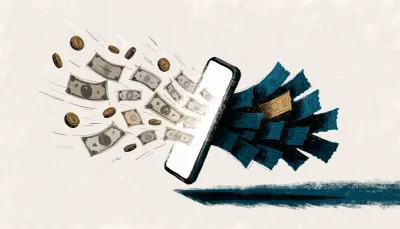
I believed that too, for longer than I'd like to admit. It's wrong. That figure is an IOU, and your bank generated it about five seconds after a total stranger asked for a loan you'll never hear about.
Here's the version most of us were taught, the one I grew up believing without ever once questioning it: you deposit RM10,000, the bank sets RM10,000 aside, then lends out whatever's left after keeping a small reserve. Neat. Reassuring. Also wrong, and once you see why, you can't really unsee it.
How a signature turns into money
I first ran into the real mechanism a few years ago, buried in a central bank paper I almost closed out of after the second paragraph. Boring title, dense prose, the kind of document that looks like it was written specifically to be ignored. In 2014, the Bank of England published a paper called "Money creation in the modern economy." Not a blogger. Not a YouTuber. The actual central bank of the United Kingdom, stating in plain language that banks "do not act simply as intermediaries, lending out deposits that savers place with them."
When a bank approves a loan, it creates a brand-new deposit and drops it straight into the borrower's account. The loan and the deposit appear at the exact same moment, born from the same signature. Nobody's savings moved, because nobody's savings were involved in the first place.
I remember sitting with that for a good ten minutes, rereading the same paragraph, waiting for the catch. There wasn't one. The money didn't come from you. It came from a keystroke, and that keystroke happens whether or not you were ever in the room.
The actual mechanism
"Keeping your money safe in the bank" and "the bank is protecting your wealth" sound like the same sentence. They're not. Your bank already lent version after version of your cash into existence for other people. What's sitting in your account now is a promise, backed by regulation and deposit insurance, not a stack of bills with your fingerprints on it.
Tap each card
Myth vs. reality: what's actually happening to your money
Myth
"The bank keeps my deposit safe until I need it."
Your deposit was lent out, often within days. What's "in" your account is a liability the bank owes you, not cash sitting in a vault.
tap to flip →
Myth
"Banks lend out a portion of the deposits people put in."
Per the Bank of England's own 2014 research, loans create new deposits. The money didn't exist before the loan was signed.
tap to flip →
Myth
"There's a big legal reserve stopping banks from over-lending."
Bank Negara Malaysia's Statutory Reserve Requirement sits at 1% as of May 2025, a 14-year low. Banks must hold back RM1 of every RM100.
tap to flip →
Myth
"Keeping cash in savings is the safe, passive move."
Idle cash still sits inside a system built to multiply for whoever holds the leverage. Passive isn't neutral. It's just slower to notice.
tap to flip →
Bank of England, "Money creation in the modern economy" (2014) · Bank Negara Malaysia, Statement on Statutory Reserve Requirement (May 2025)
The leash got looser, not tighter
Here's where it gets uncomfortable for anyone banking in Malaysia specifically, and I say this as someone who banks with a local institution too, so I'm not writing this from some outside perch. Banks are required to hold back a small percentage of deposits as a legal minimum, called the Statutory Reserve Requirement. In May 2025, Bank Negara Malaysia cut that requirement to 1%, the lowest it's been in 14 years, releasing roughly RM19 billion of liquidity straight into the banking system.
I'll be straight with you: I didn't clock that number until I went digging for this piece. A drop from 2% to 1% doesn't sound dramatic until you say it out loud as "the legal minimum just got cut in half," and almost nobody I've talked to about this had heard about it at all.
What "1% reserve" actually means
You're told this is "in your account"RM100
Legally required to be held backRM1
Already lent, re-lent, and multiplied elsewhere~RM99
Liquidity released by the May 2025 cut~RM19bn
Nothing about this is broken. It was engineered exactly like this, and "protect your savings" was never the design brief.
The cope, named plainly
Conventional financial advice tells you to "save more," like your bank account is a shed where money sits still until you need it. Saving matters, obviously, but treating your bank balance as inert, untouched capital is the same fantasy as believing your landlord keeps your rental deposit in a locked box instead of investing it somewhere else entirely. The number is real. What backs the number is a system of promises stacked on promises, and the base of that stack got 1% thinner last year while almost nobody noticed.
Why this actually matters to you, not just to economists
This changes three things about how you should actually behave with money, starting today, not next quarter.
Call a low-interest savings account "safe" one more time and see how that ages. It carries the same system-wide leverage as everything else, just with none of the upside. Banks create money by lending, lending gets easier when reserve requirements drop, and easier lending means credit expands. Expanding credit is a direct driver of asset price inflation, which is a big part of why property, equities, and even gold in Ringgit terms have been running hot this year. You're not imagining that everything costs more. You're watching the mechanism move in real time, and honestly, once you know what you're looking at, it's hard to look away.
Who's already acting on this
Banks & funds
Aren't hoarding cash. They borrow against assets to buy more assets, because they know new money gets created cheaply whenever policy loosens.
You, probably
Still hearing "build an emergency fund and wait." True as far as it goes, but a buffer isn't a strategy, and treating it like one is how you stay flat while everyone else moves ahead.
Do this in the next 24 hours
I'm not going to end this with "reflect on your relationship with money" or some other line that lets you close the tab feeling thoughtful and do nothing. Here's what I actually want you to do, in order, starting today:
- Open your bank app right now and screenshot your account balance. This costs you nothing and takes ten seconds. No excuse, I mean it.
- Search "[your bank name] loan-to-deposit ratio" and find the actual number. Every listed bank publishes this. You'll see exactly how much of "your" deposits have already gone out the door as loans to someone else.
- Move any cash sitting beyond your 3-6 month emergency buffer. If it's not doing a job, earning yield, sitting in an asset, working as a deliberate short-term reserve, it's just idle capital in a system built to keep moving for everyone except you.
- Pick one asset class you don't currently understand. Property leverage, EPF's investment scheme, index funds, whatever's closest to your current knowledge gap. Read one primary source on it this week. Not a TikTok summary, not my summary either, actually go to the source.
- Stop calling your bank balance "savings" in your own head. Call it what it is: capital sitting inside a system designed to multiply for the institution holding it, not for you. That mental shift alone will change how urgently you act on steps one through four.
You can't opt out of this system. Everyone banks somewhere, myself included. But there's a real gap between the person who understands the mechanism and moves accordingly, and the person still treating their bank balance like a locked box with their name on it.
If you want the rest of how this system actually runs, not the version taught in school but the version that shows you exactly where the leverage sits and how to stand on the right side of it, that's what I built Ascendant Collective for. I am not here to be the fairy godmother. No sugarcoating, just the parts of the system nobody bothered explaining to you.
Ascendant Collective
The financial truth nobody taught you.
Real psychology. Real history. No recycled advice. Free, every week.
Subscribe Free
Subscribe to our newsletter.
Become a subscriber receive the latest updates in your inbox.